If your house sits over a dirt-floor crawl space, the standard radon fix does not apply. There is no slab to cut a suction point through. The soil is simply open to the underside of your house, which means the crawl space is not a barrier at all. It is a plenum full of soil gas connected to your living space.
The method for this is sub-membrane depressurization, and it is a different job from basement mitigation.
How it works
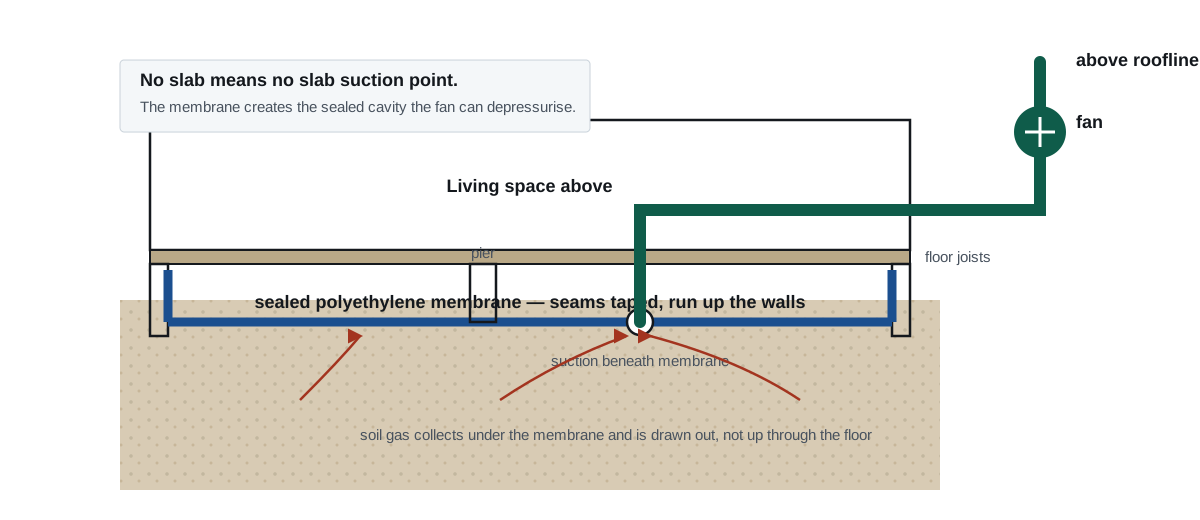
- Clear and prepare the floor. Debris and sharp material come out, because they will puncture the membrane.
- Lay heavy polyethylene across the entire crawl space floor, running it up the foundation walls and sealing it there.
- Seal every seam. Overlapped and taped, sealed around piers, posts and plumbing penetrations. The membrane’s value is entirely in how well it is sealed. A well-laid sheet with open seams accomplishes very little.
- Set a suction point beneath the membrane, connected to sealed pipe.
- Inline fan and discharge above the roofline, same as a basement system.
- Manometer on the pipe so you can confirm suction at a glance.
The membrane is what makes the fan effective. Without it the fan would simply pull conditioned air out of the crawl space forever and never depressurize the soil.
Why crawl space jobs cost more
- Labor position. Everything happens on hands and knees in a space with limited headroom.
- Membrane area. You are covering the whole footprint, not cutting one hole.
- Sealing complexity. Piers, posts, ductwork and plumbing all need individual detailing.
- Access. A small hatch means every material comes in by hand.
The mixed-foundation case, which is common here
Many Johnson County homes are a basement house with a crawl space addition attached. A 1980s expansion on a 1960s house is a familiar pattern in Shawnee, Olathe and north Leawood.
A mixed foundation usually needs two suction points: one through the basement slab, one under the crawl space membrane. A single point cannot serve both, because the foundations are not connected beneath the ground in a way that lets suction travel.
If a contractor quotes a mixed-foundation home with one suction point, ask how they intend to cover the second foundation. That is the most common way a radon system fails its verification test in this county.
Moisture and radon are the same project
The membrane that blocks soil gas also blocks water vapor. If you were already considering crawl space encapsulation for humidity, mold, or musty air, combining it with radon mitigation is meaningfully cheaper than doing them separately. The membrane, the sealing, and the crawling around are shared costs.
Verify the result
As with any mitigation, the deliverable is a post-mitigation test showing the reading dropped below 4.0 pCi/L. Johnson County’s average is 5.3 pCi/L, so a pre-existing elevated result here is unremarkable. What matters is the number after the work.
Certification
Kansas requires KDHE certification for radon mitigation performed for hire. Ask for the number, verify it at 785-296-1560.
Want a straight answer about your house? We will tell you whether an $8 to $15 test kit is enough before we quote anything.
Call (913) 421-2530Common questions
Can you mitigate radon in a crawl space?
Yes, but the method differs from a basement. Because there is no slab to cut into, a heavy polyethylene membrane is sealed across the crawl space floor and up the walls, and suction is drawn from beneath that membrane. This is called sub-membrane depressurization.
Does my crawl space need to be encapsulated first?
The radon membrane is a form of encapsulation, so the two jobs overlap heavily. If you are already planning encapsulation for moisture reasons, doing both at once is cheaper than sequencing them, because the membrane and sealing labor is shared.