No level of radon is completely safe. That is the honest starting point, and it is the EPA’s own position. Radon is a carcinogen, and risk scales with exposure rather than switching on at a threshold.
What exist instead are action levels: the points at which agencies say the risk justifies the cost of fixing it.
The four numbers that matter
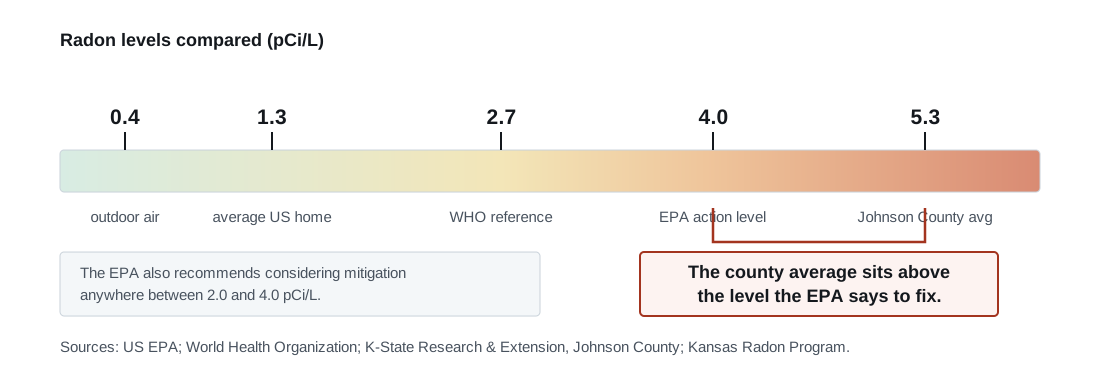
| Level | What it is |
|---|---|
| 0.4 pCi/L | Average outdoor air. The practical floor: you cannot get below ambient. |
| 1.3 pCi/L | Average indoor level in US homes. |
| 2.7 pCi/L | World Health Organization reference level. |
| 4.0 pCi/L | EPA action level. At or above this, the EPA says fix the home. |
What the EPA actually recommends
Two separate recommendations, and the second one gets skipped constantly:
- At or above 4.0 pCi/L: fix the home.
- Between 2.0 and 4.0 pCi/L: consider fixing the home.
That second band is where a lot of Johnson County houses land, and “consider” does a lot of quiet work there. A reading of 3.6 is not safe; it is below the level at which the EPA will tell you flatly to act.
Why Kansas homeowners often mitigate below 4.0
In this county the arithmetic tends to favor acting early. Johnson County averages 5.3 pCi/L, the whole county is EPA Zone 1, and a standard single-foundation system is a low four-figure, one-day job.
If you are sitting at 3.5 and planning to stay in the house for fifteen years, you are choosing between a known modest cost now and a decade and a half of exposure at nearly the action level. Plenty of people in that position mitigate, and it is a reasonable call rather than an upsell.
Levels are not a fixed property of your house
A single number is a snapshot of a moving thing. Radon readings in the same home vary by:
- Season. Winter is typically highest: the house is sealed and the stack effect pulls harder on the soil.
- Weather. Barometric pressure and heavy rain both shift readings.
- HVAC operation. Anything that changes pressure inside the house changes how hard it draws soil gas.
This is why a summer short-term test reading 3.1 should not be treated as a settled answer. A long-term test of 90 days or more gets much closer to the annual average you actually live in.
What to do with your number
- Above 4.0: mitigate. This is not a judgment call.
- 2.0 to 4.0: retest long-term, then decide. If you are staying in the home, leaning toward mitigation is defensible.
- Below 2.0: retest every couple of years, and after any foundation work, basement finishing, or major HVAC change.
Test kits from the Johnson County K-State Extension office in Olathe run about $8 to $15 including analysis. Any paid testing in Kansas must be done by a KDHE-certified professional.
Want a straight answer about your house? We will tell you whether an $8 to $15 test kit is enough before we quote anything.
Call (913) 421-2530Common questions
Is 2.5 pCi/L safe?
It is below the EPA action level of 4.0 but above the WHO reference of 2.7 and far above outdoor air at 0.4 pCi/L. The EPA suggests considering mitigation between 2 and 4 pCi/L. Many Johnson County homeowners at that range choose to mitigate because the cost is modest.
What is the average radon level in Johnson County?
Johnson County homes average 5.3 pCi/L, above the EPA action level of 4.0. The Kansas statewide average is 4.9 pCi/L, and 41 percent of more than 46,000 Kansas measurements came in at or above 4.0 pCi/L.