A radon fan runs 24 hours a day, every day, for years. Like anything with a motor and a bearing, it eventually stops. What makes this failure unusual is that nothing tells you. No alarm, no smell, no change you can feel. The radon simply comes back.
Check your manometer right now
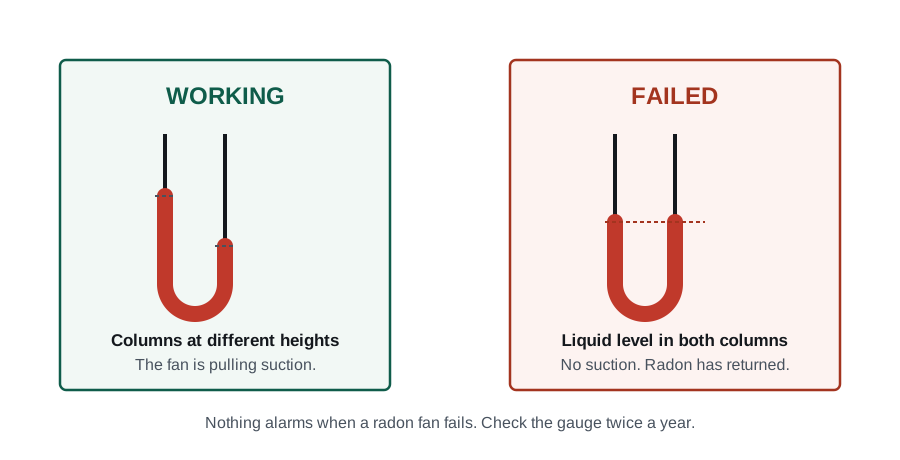
Every properly installed system has a manometer, a small clear U-shaped tube mounted on the radon pipe, partly filled with colored liquid.
- Liquid at two different heights → the system is under suction and working.
- Liquid level in both columns → there is no suction. Your fan has probably failed.
That is the entire diagnostic, it takes five seconds, and most homeowners have never been told to look. Go look now, then come back.
Why fans die quietly
Radon fans are rated for continuous duty, and most last 5 to 10 years. Failure modes we see in Johnson County:
- Bearing wear. The fan still spins but moves far less air. Suction drops below what the soil needs, and the manometer difference narrows before it disappears.
- Motor burnout. Total stop. Manometer goes level.
- Iced or blocked discharge. Kansas winters can restrict an improperly terminated discharge point.
- Disconnected power. A tripped breaker or an outlet switched off during a project. We have found systems that were off for years because someone unplugged the fan to run a saw.
- Cracked or separated pipe. Especially at joints in unconditioned attic space, where temperature swings work on the glue.
What replacement involves
- Test the existing system: measure suction at the pipe and confirm the fan is actually the failure.
- Size the replacement to your soil, not to the old label. If the original fan was undersized, replacing it with the same model reproduces the original problem.
- Inspect the whole system: pipe joints, sump cover gasket, slab seals, and the discharge termination. Fan replacement is the natural moment to fix the rest.
- Replace and re-verify. A post-repair radon measurement confirms the level came back down below 4.0 pCi/L.
When repair is not the answer
Sometimes the fan is fine and the system was never adequate. If your original install had one suction point but your house has a basement plus a crawl space addition, no fan will fix a coverage problem. In that case the honest recommendation is a second suction point rather than a bigger motor.
We will tell you which one you have after testing, before quoting.
If you inherited the system with the house
Ask two questions: when was the fan installed, and is there a post-mitigation test on file? If you cannot answer either, test the house. A $8-15 kit from the Johnson County Extension office in Olathe will tell you whether the system you inherited is still doing anything.
Certified service only
Kansas requires current KDHE certification for radon mitigation work performed for hire, including system repair, under the Kansas Radon Certification Law. Ask for the certification number. Verify it with KDHE at 785-296-1560 or kdhe.radon@ks.gov.
Want a straight answer about your house? We will tell you whether an $8 to $15 test kit is enough before we quote anything.
Call (913) 421-2530Common questions
How do I know if my radon fan has failed?
Look at the manometer, the small clear U-shaped tube on the radon pipe. If the liquid sits level in both columns, the system is not pulling suction and the fan has likely failed. A working system shows the two columns at clearly different heights.
How long does a radon fan last?
Most inline radon fans run 5 to 10 years of continuous operation. They rarely fail loudly. The usual outcome is that the fan quietly stops moving enough air, radon returns to pre-mitigation levels, and nobody notices until the manometer is checked.